
On this page
Before planning hot pot in a rented party room, confirm that the host allows the chosen cooking appliance, where it may sit, which fixed socket it may use, and whether chilled ingredients can stay cold until cooking. Then arrange the table so raw food and its utensils cannot be confused with cooked food, and keep the hot pot away from guest traffic. A feature label or attractive dining photo is only a starting point; permission and facilities belong to the particular venue.
Is the room actually suitable for table cooking?
Ask the venue whether hot pot is permitted, whether it supplies an induction cooker or guests may bring one, and whether there are limits on soup, smoke, odour, cleaning or disposal. Do not assume that permission to bring takeaway means permission to boil food at the table. Ask what table surface is intended, whether it is stable and heat-appropriate, and where the nearest suitable fixed socket is. Request a photo or layout if the table and sockets are not clear from a listing. Get the answer before buying ingredients.
The number of seats alone does not tell you whether the room can host a hot pot meal. Diners need reachable places for raw ingredient trays, cooked bowls, condiments, drinks and the pot without crowding the hot surface. A guest should not have to step over a power cord or reach across steam to pass a drink. Confirm there is a handwashing point with liquid soap and a clean surface for food preparation. If the venue lacks the storage or washing conditions your menu needs, simplify the menu or choose another room.
Do not import a restaurant's permissions into a private room. The venue host must confirm permitted use and its own house rules. If an open flame is proposed, ask specifically rather than assuming it is interchangeable with induction. This article's electrical plan concerns an electric pot; a flame-based setup would need a separate venue assessment. Do not bring unapproved fuel or equipment as an improvised fallback.
Put the electric cooker on a safe power route
The Electrical and Mechanical Services Department's appliance guidance says high-power appliances, including electric water kettles or pots, should draw from a single fixed socket without another appliance connected to it. It advises checking plugs and cords for damage, placing appliances on firm flat surfaces, keeping cords away from hot objects, preventing water from reaching electrical equipment, and avoiding extension units in wet or humid environments. Apply those conditions to the actual appliance and room rather than guessing that any spare socket will do.
Before guests arrive, inspect the pot, plug and cord and read the appliance's own instructions. If anything is worn, loose or discoloured, do not use it; ask the host for a safe alternative. Place the pot on the confirmed stable surface with enough room around it, where a seated person will not brush the control or pull the cord. Route the cord so it is not stretched across a walkway, pinched by a chair, close to the hot vessel, or exposed to spilled soup. Keep drinks and a soup refill jug away from the socket and controls.
Do not solve an inconvenient socket by daisy-chaining adaptors or running an extension across the floor. EMSD's advice about single fixed sockets and wet environments is a reason to ask for a better layout. If the table cannot be arranged around a suitable power point, the right decision may be a different venue or a different meal. Switching off and unplugging a cooker should be done according to its instructions; EMSD recommends switching off before unplugging, with dry hands.
Plan a cold chain that the room can support
The Centre for Food Safety's hot pot guidance says chilled ingredients should be kept at 4°C or below and frozen ingredients at -18°C or below. It says not to defrost at room temperature, and favours a refrigerator, cold running water or microwave as appropriate methods. Ask the venue what refrigerator or freezer access actually exists and how much space is available. A decorative mini-fridge or a drinks cooler should not be assumed to hold a group meal at the necessary conditions.
Plan the journey from purchase to the pot. Buy from a reliable retailer, check packaging and use-by dates, and arrange transport so raw meat and seafood remain separated from ready-to-eat items. If you cannot keep a particular ingredient properly chilled through travel, setup and service, do not buy it for that event. For food brought frozen, decide where and when it will defrost using a safe method; arriving with a frozen block and leaving it on the table is not a plan. Some small frozen items can cook directly from frozen if the product instructions and thorough cooking allow it, but do not generalise that to large portions.
Bring out small amounts to the table and replenish from cold storage when needed, rather than placing every raw tray beside the pot at the start. The CFS warns that crowded raw and cooked dishes raise cross-contamination risk. If the room has no reliable cold storage, a menu built from fresh perishable trays may be unsuitable. Ask whether the venue can support a shorter meal with ingredients delivered just before use, or choose another format; do not rely on an unverified cooler.
Give raw and cooked food separate routes
Set one side for raw ingredients and clearly different utensils for putting them into the pot. Reserve another side for clean bowls, cooked portions and ready-to-eat foods. Explain the rule to the group before the first round. A guest using eating chopsticks to lift raw meat and then returning them to a cooked bowl defeats the separation. Use visibly different tongs or chopsticks and keep each set in its own marked place. Wash hands with liquid soap before food handling, after touching raw meat or seafood, and before touching ready-to-eat food; CFS specifies at least 20 seconds for proper handwashing.
Do not overload the pot. The CFS says food should be taken out only after soup has returned to a full boil when water or soup is added, and that overfilling can lead to uneven cooking. Larger pieces need thorough cooking; its hot pot guidance gives a core temperature of at least 75°C. Shellfish has separate, stricter advice: heat to an internal 90°C for 90 seconds, or boil at 100°C until shells open and continue for three to five minutes. A casual countdown for every ingredient cannot replace these conditions. If the group cannot manage an ingredient confidently, leave it off the menu.
Avoid raw egg as a dip: CFS warns of Salmonella risk and suggests pasteurised shell eggs instead. Spicy sauce, wasabi or alcohol does not make contaminated raw food safe. For the people who handle the pot, keep a designated spot for the lid, a safe way to add soup without reaching over another guest, and a place where hot utensils can rest without touching clean food. Tell guests where the hot edge is, especially when someone stands up or passes behind a chair.
Make clearing and leftover decisions before the meal
Ask the host how to dispose of soup and food scraps. Do not pour a pot of hot broth into a sink or bin without an approved method. Confirm who washes the cooker and table, where wet utensils go, and how long the group has to cool, pack and leave the room. Set aside clean, lidded containers only for food whose handling history allows safe storage. A pile of raw meat that has stood on the table through the meal should not be given to guests as a "take-home bonus."
CFS guidance on handling leftovers explains that cooked food for later use should be cooled promptly and refrigerated within two hours. Food in the 4°C to 60°C range for two to four hours is for immediate consumption only; after more than four hours it should be discarded. Record when food leaves safe storage rather than trying to reconstruct it at midnight. Any food you retain needs a real cold route home, not just a container. When that route is unavailable, buy less and discard unsafe remnants.
Worked example: one table, one induction pot
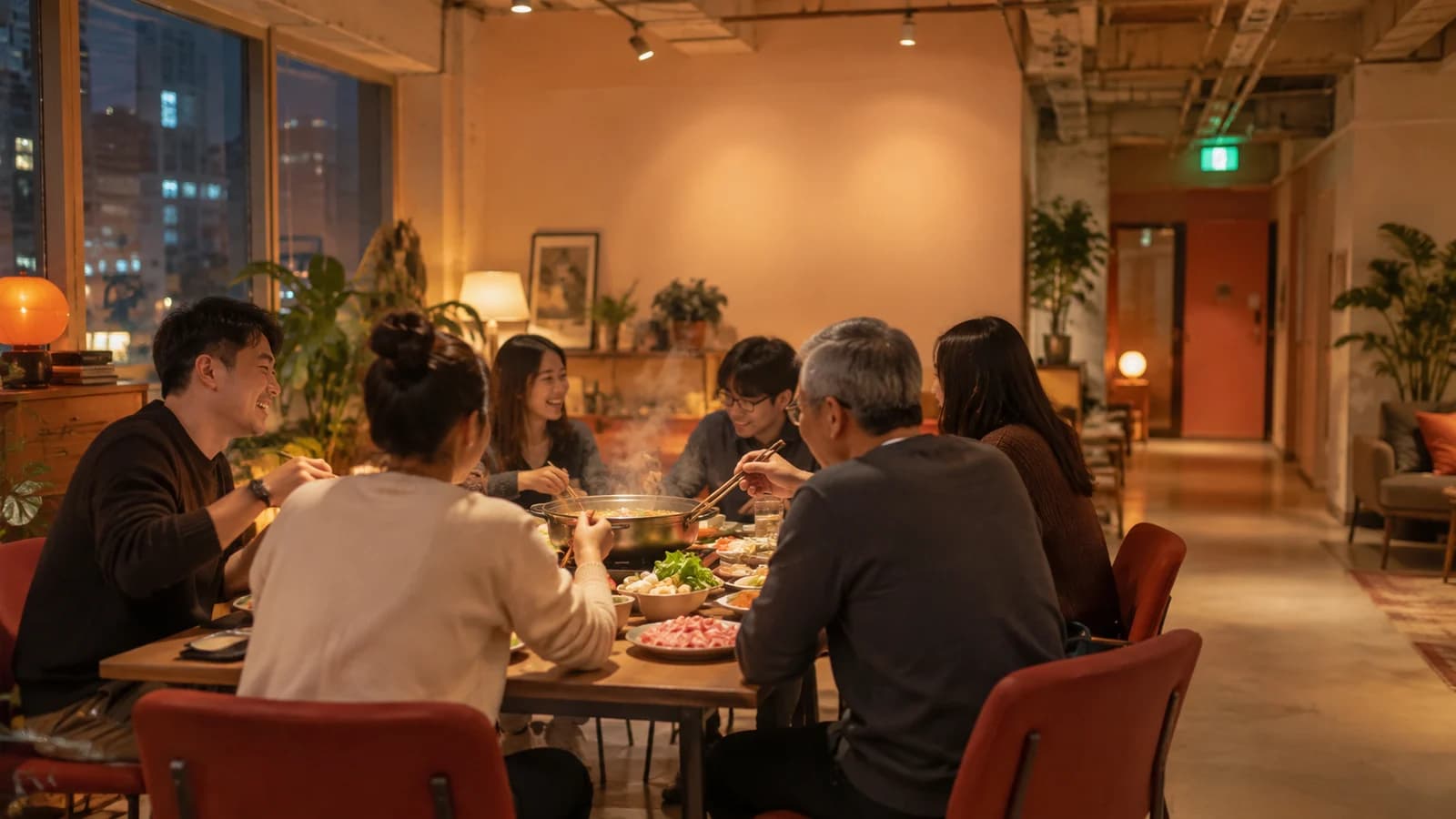
Imagine a hypothetical eight-person gathering in a room whose host has confirmed table cooking, an induction unit, a suitable fixed socket and a refrigerator with enough space for the chosen ingredients. The organiser maps the pot at one end of a firm table, a raw-food area beside the person adding ingredients, and a separate clean area for cooked bowls. The power cord reaches the wall without crossing the walkway. Two different utensil sets are identified, and a guest is responsible for returning perishable trays to the refrigerator between rounds.
Before eating, the organiser checks the appliance, explains the raw-versus-cooked rule and keeps the pot below an overfilled state. When broth is topped up, everyone waits for a full boil before removing food. A planned clearing period allows the group to cool equipment and follow the venue's soup-disposal instructions. The eight people, equipment and facilities here are hypothetical; they are not a claim that a real listing supplies any of them.
A final venue decision checklist
A suitable room must pass four questions together: Does the host permit the exact cooking method? Can the appliance use a safe fixed socket and stable table without a trip or spill route? Can the proposed perishable ingredients remain at safe temperatures? Can guests wash hands, separate raw and cooked food, and clear the room as instructed? If one answer is missing, resolve it with the host before placing a food order. If it cannot be resolved, choose a simpler meal or a more suitable space.
Use search to compare party-room features and the party checklist to assign equipment, food and cleaning tasks. Gatherland's current public preview does not prove live inventory or a room's exact facilities. A safe hot pot plan rests on confirmed venue conditions and the group's handling of the equipment and food, not on the cover photograph.
Found this useful?
Send it to the friends you're planning with.