
Paper-grid direction puzzle

Draw a four-by-four grid with columns A–D from left to right and rows 1–4 from bottom to top. One partner reads a route card; the other marks the route without seeing the card. “Up” always increases the row number, not the direction the paper is facing. All movement stays on paper: this activity does not require blindfolds or navigating a room.
- Time
- Suggested: 15 minutes
- Participants
- Pairs
- Materials
- Two labelled grids per pair and pens
How to use it
- Give both partners the same labelled grid. Establish that each instruction moves exactly one adjacent square.
- Read the starting square, then one direction at a time. The listener can request that an instruction be repeated.
- Compare the marked path and final square with the facilitator note. Swap roles for the next card.
Activity cards
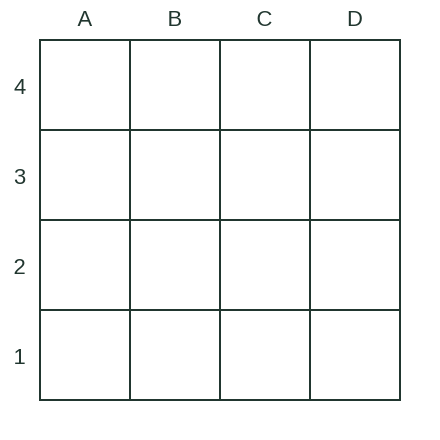
Across then up
- Task
- Start A1: right, right, up, up.
- Facilitator note
Facilitator note
End C3. Path: A1, B1, C1, C2, C3.
A corner route
- Task
- Start D4: down, down, left, left.
- Facilitator note
Facilitator note
End B2. Path: D4, D3, D2, C2, B2.
A small loop
- Task
- Start B2: up, right, down, left.
- Facilitator note
Facilitator note
End B2; the route returns to its start.
A zigzag
- Task
- Start A1: up, right, up, right, up.
- Facilitator note
Facilitator note
End C4. Path: A1, A2, B2, B3, C3, C4.
Across the top
- Task
- Start A3: up, right, right, right, down.
- Facilitator note
Facilitator note
End D3. Path: A3, A4, B4, C4, D4, D3.
Return by another path
- Task
- Start C1: left, up, up, right, down, down.
- Facilitator note
Facilitator note
End C1. Path: C1, B1, B2, B3, C3, C2, C1.
Open the CSV in Excel, Numbers or Google Sheets. Save a copy before editing.
Agree the reference frame
Rotate neither grid during a round. Left and right refer to columns, while up and down refer to numbered rows. If the route tries to leave the grid, stop and check the last instruction instead of inventing an extra square. The included answer gives the final coordinate; the full path remains useful for finding where a misunderstanding occurred.
Use the second round to improve instructions
After one round, partners choose whether to add coordinates after each move or keep direction-only instructions. Compare how that changes checking, not which partner is cleverer. Someone who prefers reading to listening can use written instructions; cover the destination answer until the route is complete.
Continue planning
- Written message relay and comparison pack
Compare how a short practical message changes when each person rewrites it from memory.
- A cooperative drawing challenge
Use simple descriptions and shared drawing to build one picture, with original prompt cards.